
Mitsubishi Carbide Drill Replacements
Index
A suitable Mitsubishi carbide drill replacement must match the application. Check the workpiece material, hole depth, coolant delivery, machine conditions, tool dimensions, and the problem the new drill needs to solve.
If the current drill is chipping, wearing unevenly, packing chips, or becoming difficult to source, identify the cause first. Review current Mitsubishi products and any official successor before evaluating drills from other manufacturers.
When to replace a Mitsubishi carbide drill
Most replacement searches begin with a machining problem, a change in the application, or a supply issue. Defining the reason helps determine whether the drill, the process, or the original tool selection needs to change.
Recurring chipping or unstable tool life
Edge and corner chipping can result from excessive runout, unstable toolholding or workholding, unsuitable cutting data, insufficient coolant, poor chip evacuation, or use beyond the established wear limit.
Check these conditions before starting a tool trial. If the process remains unstable after correcting the setup, evaluate drills with a different carbide grade, coating, point geometry, margin design, flute shape, or coolant configuration.
Poor chip evacuation or hole quality
Chip control becomes more demanding as hole depth increases. Packed or poorly formed chips can damage the cutting edge, reduce surface quality, affect dimensional consistency, and cause sudden breakage.
Record the chip shape, hole depth, coolant pressure and flow, filtration, and the point at which buildup begins. Select a candidate designed to address the chip-control problem.
Changes to the workpiece or hole
A drill selected for one application may become unsuitable after a change in material, hardness, hole depth, entry surface, tolerance, or bottom geometry.
Moving from carbon or alloy steel to stainless steel changes the demands on edge geometry, heat control, chip evacuation, coating, and coolant delivery. Small-diameter deep holes introduce another set of requirements.
Identify the Mitsubishi drill
Start with the exact tool. A family such as MVS includes many diameters, depth ratios, shank dimensions, and order numbers, so the family name alone is insufficient for cross-referencing.
Record the order or EDP number
Save the Mitsubishi order number or EDP number to confirm product status and compare the current drill with a successor or third-party candidate.
Also record the series, diameter, overall length, flute length, usable length, shank diameter, drilling depth, coolant type, and any dimensional tolerance that affects the process.
Document the machining conditions
Record the workpiece grade and hardness, hole type, depth-to-diameter ratio, entry and exit conditions, spindle capability, holder, measured runout, coolant delivery, and current speeds and feeds.
These details provide the trial baseline. Without them, a catalog match may be tested under conditions developed for a different drill.
Define the required improvement
State the replacement objective clearly. It may be lower corner chipping, slower flank wear, better chip evacuation, improved hole finish, tighter dimensional control, more predictable tool life, shorter cycle time, or better availability.
Use the current failure mode as a selection requirement. A drill chosen to reduce edge chipping may need different characteristics from one selected for deep-hole chip evacuation.
Replacing an older or discontinued Mitsubishi drill
Mitsubishi's Web Catalogue uses product-status indicators for standard inventory, made-to-order items, and products being maintained while newer products are introduced.
Check the exact product status
Search by order number or EDP number. Individual items within the same family can have different availability or transition status.
An older series name does not confirm that every product in the range has reached end of life. Verify the exact item in Mitsubishi's current catalog or through the manufacturer or distributor.
Review the official successor
If Mitsubishi identifies a newer product, check its diameter, tolerances, overall and flute lengths, shank, point geometry, coolant configuration, workpiece range, and cutting recommendations against the existing drill.
A designated successor may still require different speeds, feeds, or coolant conditions. Establish a new baseline before releasing it into production.
What to compare in a replacement drill
Use the current Mitsubishi tool and its proven process as the reference for every candidate.
| Selection factor | What to confirm |
|---|---|
| Current Mitsubishi tool | Series, order number or EDP number, and product status |
| Workpiece | Material grade, hardness, heat treatment, and surface condition |
| Hole geometry | Diameter, tolerance, depth-to-diameter ratio, blind or through hole, and bottom geometry |
| Entry and exit | Flat, angled, curved, interrupted, cross-hole, or pre-drilled surface |
| Drill dimensions | Overall length, flute length, usable length, shank diameter, and holder compatibility |
| Point and cutting geometry | Point angle, margins, cutting-edge design, flute geometry, and pilot-hole requirements |
| Coolant | Internal or external delivery, pressure, flow, concentration, and filtration |
| Machine and holder | Spindle speed, available power and torque, rigidity, overhang, and measured runout |
| Cutting data | Cutting speed, feed per revolution, pecking strategy, and entry conditions |
| Performance target | Tool life, hole quality, cycle time, process consistency, and cost per acceptable hole |
Prioritize the condition behind the replacement search. Stainless steel drilling requires different geometry and coolant characteristics from a steel application focused on tool life or a deep hole affected by chip packing.
Solid carbide drill brands to compare with Mitsubishi
The following product families cover different materials, hole depths, coolant arrangements, and drilling problems. Treat them as candidates for technical review and machining trials, not confirmed one-to-one replacements.
NACHI AQUA REVO Drill Series

Source: NACHI America Official Website
NACHI's AQUA REVO range includes Stub and Regular drills as well as AQUA REVO Oil Hole drills. The Oil Hole series is available in 3D, 5D, and 8D versions and uses NACHI's REVO Power Cooler oil-hole geometry for cooling, lubrication, and chip evacuation.
Review the exact AQUA REVO configuration when edge damage, coolant delivery, or chip evacuation is driving the search. Confirm the diameter, depth, coolant system, dimensions, and workpiece range before testing.
Guhring RT 100 U

Source: Guhring Official Website
Guhring's RT 100 U Series 5511 is a 5xD solid carbide drill with through-coolant delivery. Published specifications include a 140-degree point angle, nano-FIREX coating, and a straight main cutting edge.
Guhring lists steel and cast iron as optimal application groups for this series. Stainless steel, non-ferrous materials, special and titanium alloys, and hardened materials are listed as secondary groups. Check the material classification, dimensions, and cutting recommendations against the Mitsubishi process.
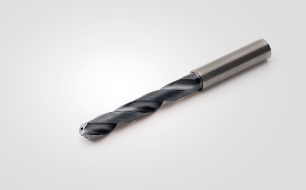
Seco Feedmax
Source: Seco Tools Official Website
Seco organizes its Feedmax solid carbide drills by workpiece and application. Feedmax-P covers steel and cast iron, Feedmax-MS covers stainless steel and superalloys, and Feedmax-N covers aluminum and other non-ferrous materials.
The range also includes deep-hole products, including 16xD and 30xD options and additional families for longer holes. Select by the exact Feedmax variant, material group, depth, diameter, and coolant requirements.
OSG A Brand ADO / ADO-SUS
Source: OSG Official Website
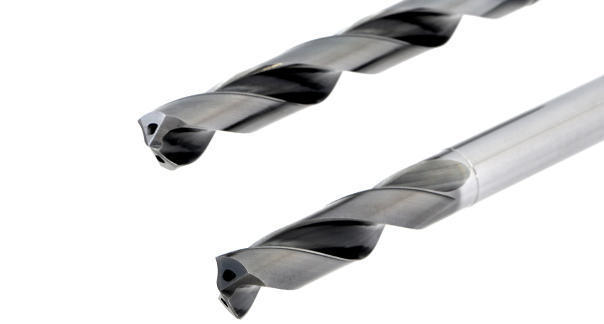
OSG's ADO family provides through-coolant carbide drilling options. ADO-SUS is intended specifically for stainless steel and titanium alloys.
OSG lists dedicated cutting-edge, flute, margin, and coolant-hole designs for controlling work hardening, chips, friction, and heat in these materials. Review ADO-SUS when stainless steel or titanium machining is the main concern, and confirm the exact depth series, diameter, coolant requirements, and cutting data.
Sandvik CoroDrill 860-GM
Source: Sandvik Coromant Official Website
https://www.sandvik.coromant.com/en-us/tools/drilling-tools/solid-carbide-drills/corodrill-854-856
https://www.sandvik.coromant.com/en-us/tools/drilling-tools/solid-carbide-drills/corodrill-854-856
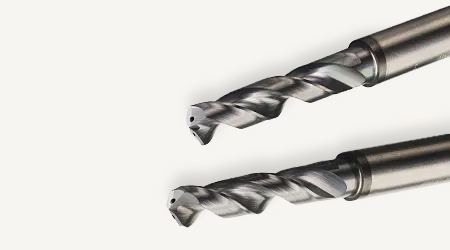
Sandvik Coromant describes the CoroDrill 860 with -GM geometry as a solid carbide drill for multi-material, short-hole applications. Its primary material groups include ISO P, M, K, and H.
Consider this range when replacing a general-purpose Mitsubishi drill used across several material groups. Check the exact diameter, drilling depth, coolant configuration, geometry, shank dimensions, and Sandvik cutting recommendations.
Mitsubishi drill replacement options by application
Use this table to focus your product research. The products shown are trial candidates, not verified drop-in replacements.
| Current application or problem | Mitsubishi option to check | Other family to investigate | What to verify |
|---|---|---|---|
| General through-coolant carbide drilling | MVS | Sandvik CoroDrill 860-GM | Material group, diameter, depth, coolant, and geometry |
| Recurring edge or corner chipping | Review current MVS/MVE geometry and cutting conditions | NACHI AQUA REVO | Failure location, geometry, coolant, depth, and workpiece |
| 5xD through-coolant drilling | MVS 5xD configuration | Guhring RT 100 U Series 5511 | Dimensions, point geometry, material group, and speeds and feeds |
| Stainless steel drilling | MMS | OSG ADO-SUS | Diameter, hole depth, coolant, chip control, and cutting data |
| Material-specific or deeper drilling | DVAS or another dedicated Mitsubishi family | Seco Feedmax | Exact depth ratio, material group, coolant, and pilot requirements |
| Tool-management or replaceable-head strategy | DXAS | Evaluate separately from the current solid carbide process | Holder system, head range, drilling depth, machine setup, and total process cost |
Check compatibility before installation
Confirm dimensions and geometry
Drills with the same nominal diameter can differ in overall length, flute length, usable length, shank dimensions, point geometry, margins, coolant-hole design, carbide grade, and coating.
Point angle, flute shape, edge preparation, and coolant-hole geometry also affect chip formation, cutting forces, heat generation, centering, and the suitable operating range.
Use terms such as direct, drop-in, or interchangeable replacement only after technical compatibility has been confirmed for the exact products.
Use the candidate manufacturer's cutting data
A replacement may need different speeds and feeds even when the diameter and workpiece remain unchanged. Begin with the manufacturer's recommendations for the exact drill and material.
After the process is stable, adjust one major variable at a time while monitoring wear, chip evacuation, hole quality, cycle time, and tool life.
Frequently asked questions
What is a suitable replacement for a Mitsubishi carbide drill?
Identify the exact Mitsubishi order number or EDP number, then match the workpiece, diameter, drilling depth, dimensions, coolant configuration, machine conditions, and required hole quality. Check current Mitsubishi options before building a cross-brand shortlist.
How do I replace a discontinued Mitsubishi drill?
Check the product status by order number or EDP number and review any official Mitsubishi successor. If no current Mitsubishi option meets the requirement, use the original specifications and machining records to identify third-party candidates.
Can I use the same speeds and feeds?
Start with the replacement manufacturer's cutting data. Differences in carbide grade, coating, geometry, margins, and coolant design can change the recommended operating range.
Should I replace a Mitsubishi drill that keeps chipping?
Inspect runout, toolholding, workholding, cutting data, coolant delivery, chip evacuation, entry conditions, and current wear first. If chipping continues under controlled conditions, test a drill design that addresses the observed failure.
Find a solid carbide drill for your application
Define the workpiece, hole geometry, coolant delivery, machine conditions, and current failure mode. Use those details to shortlist Mitsubishi and third-party options, then confirm the selection through controlled machining trials.