
Carbide Drill Finder » Carbide Drills for Steel
Carbide Drills for Steel
In today’s steel machining, where materials are becoming increasingly stronger, wear, heat generation, and hole accuracy are three critical challenges that must be addressed.
This article introduces examples of carbide drills designed to overcome these key issues in steel processing.
AQUA DRILL EX
FLAT SERIES
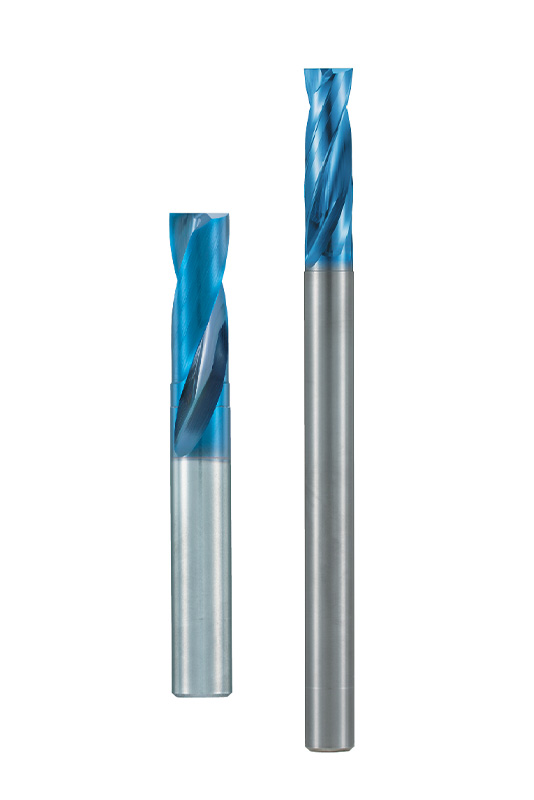
This high-performance carbide drill is designed to handle a wide range of applications—including drilling on inclined or curved surfaces, spot facing, and thin-wall machining—in a single step.
Despite having no centering feature, its 180° flat tip geometry prevents walking at the start of drilling, delivering excellent positioning accuracy.
The flat cutting edge also minimizes burrs at hole exit and enables high-precision spot facing without the need for end mills.
| Product Lineup | Super Stub Length:Ø2.0 mm – Ø20.0 mm (approx. 0.079" – 0.787") Stub Length:Ø0.2 mm – Ø20.0 mm (approx. 0.008" – 0.787") Corner Radius:Ø3.0 mm – Ø12.0 mm (approx. 0.118" – 0.472") Jobber Length:Ø3.0 mm – Ø20.0 mm (approx. 0.118" – 0.787") Long Shank:Ø3.0 mm – Ø20.0 mm (approx. 0.118" – 0.787") 3XD Length: Ø1.0 – Ø16.0 mm (approx. 0.039” – 0.630”) 5XD Length: Ø1.0 – Ø16.0 mm (approx. 0.039” – 0.630”) |
|---|---|
| Coolant Compatibility | Equipped with oil holes |
| Coating Types | AlCrTi-based lubrication coating + TiAl-based oxidation-resistant layer |
| Manufacturer Name | Nachi America |
GOdrillTM・8xD
Source: Kennametal Official Website
https://www.kennametal.com/us/en/products/fam.godrill-8xd-internal-coolant-straight-shank-metric.100161433.html
https://www.kennametal.com/us/en/products/fam.godrill-8xd-internal-coolant-straight-shank-metric.100161433.html
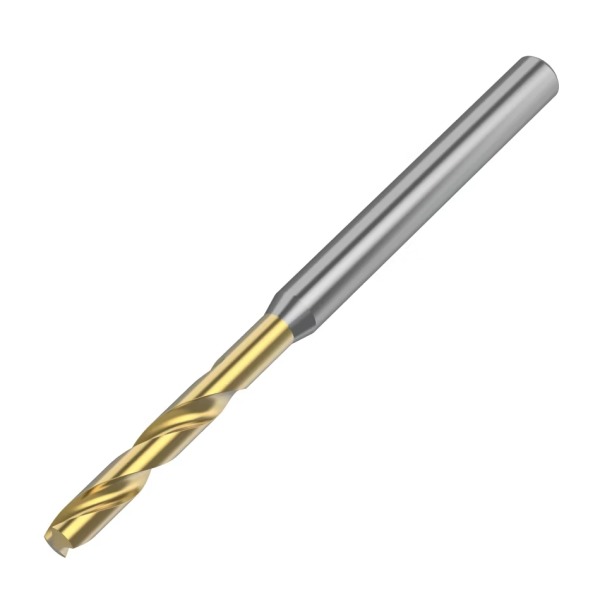
This is a versatile solid carbide drill designed for a wide range of materials—including steel, stainless steel, cast iron, non-ferrous metals, and heat-resistant alloys.
It supports deep-hole drilling up to 8×D and is engineered to handle demanding operations such as deep drilling in difficult-to-machine materials and cross-hole applications.
| Product Lineup | Drilling diameter: 1–20 mm (supports up to 8×D depth) |
|---|---|
| Coolant Compatibility | Through-coolant capable |
| Coating Types | Dual-layer coating with TiN top layer |
| Manufacturer Name | Kennametal |
Challenges
in Steel Drilling
When drilling steel workpieces with carbide tools, three main challenges typically arise.
This section explores how the properties of steel affect tool performance and the types of stresses imposed on carbide drills.
Wear Caused by
High-Hardness Materials
Drilling alloy steels such as chromoly steel (SCM) and high-carbon steel (S50C) puts extreme stress on cutting tools due to the materials' high hardness and toughness. This often leads to rapid edge wear and significantly reduced tool life.
Wear mechanisms include abrasive wear from hard inclusions, diffusion wear from overheating, and even catastrophic edge chipping.
Heat Generation
Steel has lower thermal conductivity than materials like aluminum or copper. As a result, the frictional heat generated during high-speed machining tends to accumulate around the cutting edge and hole walls.
This heat buildup accelerates tool degradation—causing edge failure and diffusion wear—and can also lead to thermal expansion or contraction of the workpiece.
Such effects often result in undersized holes and reduced dimensional accuracy.
Maintaining Hole Accuracy
Ensuring high hole quality—particularly roundness and straightness—is a major concern in steel drilling.
The high cutting resistance of hard materials can cause tool deflection and chatter, leading to deviations in the tool path.
This compromises roundness and straightness, while tool walking during hole entry also reduces initial positioning accuracy.