
Carbide Drill Finder » Carbide Drills for Cast Iron
Carbide Drills for Cast Iron
Cast iron machining presents challenges such as chip dust clogging, rapid tool wear, and reduced hole and surface quality.
To ensure stable high-efficiency and unmanned operations, addressing these issues is essential.
This article explains how to overcome these challenges using real-world examples of carbide drill solutions.
AQUA REVO DRILL
OIL HOLE

Source: Nachi America Official Website
https://www.nachiamerica.com/products/247-aqua-revo-oil-hole-drill-series/
https://www.nachiamerica.com/products/247-aqua-revo-oil-hole-drill-series/
This carbide drill is engineered for superior cooling, lubrication, and chip evacuation.
Its advanced heat management helps prevent chip dust buildup—common in cast iron machining—and extends tool life while improving stability in high-speed, high-feed operations.
When combined with the newly developed REVO-D coating, it delivers excellent durability and machining accuracy across a wide range of materials, including difficult-to-machine alloys.
| Product Lineup | Available in 3×D, 5×D, and 8×D depth options |
|---|---|
| Coolant Compatibility | “REVO Power Cooler” oil hole system |
| Coating Types | “REVO-D” multilayer nano-coating (AlCr / AlTi-based) |
| Manufacturer Name | Nachi America |
*Source: Nachi America Official Website
https://www.nachiamerica.com/products/247-aqua-revo-oil-hole-drill-series/
https://www.nachiamerica.com/products/247-aqua-revo-oil-hole-drill-series/
*Source: Nachi America Official Website
https://www.nachiamerica.com/download/445-aqua-revo/
https://www.nachiamerica.com/download/445-aqua-revo/
FORCE X
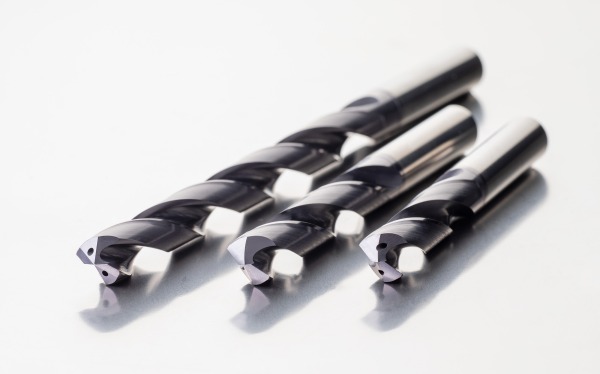
Source: Dormer Pramet Official Website
https://www.dormerpramet.com/uk-ie/en/solid-carbide-drills
https://www.dormerpramet.com/uk-ie/en/solid-carbide-drills
This carbide drill is designed to deliver both high performance and cost-efficiency across a wide range of materials, including carbon steel, alloy steel, and cast iron.
It features Dormer Pramet’s unique CTW™ flute geometry, which maintains a consistently thin core to reduce thrust force while preserving strength.
This enhances chip evacuation and makes the drill easier to regrind.
| Product Lineup | Available in jobber, short, and standard lengths |
|---|---|
| Coolant Compatibility | Supports both internal and external coolant |
| Coating Types | TiAlN coating |
| Manufacturer Name | Dormer Pramet |
*Source: Dormer Pramet Official Website
https://www.dormerpramet.com/uk-ie/en/solid-carbide-drills
https://www.dormerpramet.com/uk-ie/en/solid-carbide-drills
Challenges
in Cast Iron Machining
In high-efficiency and unmanned machining of cast iron, effective management of chip dust, suppression of tool wear, and consistent hole accuracy are critical for stable production. This section outlines the mechanisms behind these challenges.
Managing Chip Dust
One of the main issues in cast iron machining is the generation of fine, powder-like chips—often referred to as chip dust.
These particles tend to accumulate in the drill flutes. Once clogged, they hinder chip evacuation and may adhere to the tool surface.
If not properly managed, poor chip evacuation can cause chips to become trapped between the drill and the hole wall, accelerating tool wear.
In severe cases, this leads to a sudden increase in cutting resistance, which can cause tool breakage or defective machining.
Rapid Tool Wear
Tool wear progresses faster than expected during cast iron drilling due to two main factors.
First, hard particles like free carbon and silicon within the material structure act as abrasives, leading to aggressive wear at the cutting edge. Second, the heat generated by high-efficiency machining degrades tool coatings and softens the carbide substrate—resulting in thermal wear.
Unchecked wear not only reduces hole accuracy over time, but also increases the risk of chipping or tool breakage, which may halt production and cause serious downtime.
Maintaining Hole Accuracy
and Surface Finish
Achieving stable hole quality and surface finish is also a major challenge in cast iron machining. The root cause lies in the material’s inherent non-uniformity.
Variations in hardness or the presence of blowholes can cause sudden changes in cutting resistance as the drill passes through the material. Even highly rigid carbide drills may experience slight deflection or vibration (chatter) under such conditions.
This micro-vibration can reduce roundness and straightness, while also creating rough or inconsistent surface finishes. As a result, the risk of requiring rework or producing defective parts increases, affecting overall process efficiency.