
Walter Tools
Index
Automotive and aerospace engineers often face tool wear, short tool life, and rising production costs when machining difficult materials such as stainless steel and titanium.
This article looks at Walter Tools’ high-performance solid carbide drills and how they support stable performance in demanding machining conditions, helping improve tool life, hole quality, and production efficiency.
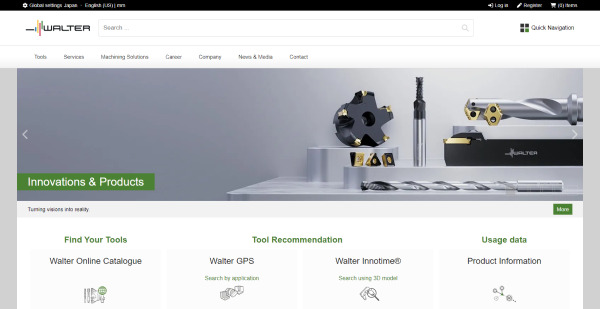
Source: Walter Tools Official Website
https://www.walter-tools.com/en-us
https://www.walter-tools.com/en-us
Recommended
Applications
for Walter Tools
Walter Tools solid carbide drills are well suited for manufacturers that need stable hole quality, high productivity, and reliable performance in demanding machining environments.
They are especially useful for automotive, aerospace, and general machining applications involving deep-hole drilling, small batches, high part variety, or difficult-to-machine materials.
Key design features include internal coolant channels, chip-evacuation-focused geometry, heat-resistant multilayer coatings, and cutting edge designs that support stable hole positioning.
These features help reduce heat buildup, chip clogging, tool wear, and hole accuracy issues, supporting better machine uptime and more consistent production quality.
Note: Actual performance may vary depending on machining parameters such as speed, feed rate, coolant conditions, and machine rigidity.
How to Choose Carbide Drills
from Walter Tools
For High-Performance Production Drilling

Source: Walter Tools Official Website
https://www.walter-tools.com/en-us/search/product/dc170-05-06.200a1-wj30ej
https://www.walter-tools.com/en-us/search/product/dc170-05-06.200a1-wj30ej
Recommended Series: Supreme
For demanding materials, high-speed machining, and production environments where reliability matters, Walter Tools’ Supreme series is the high-performance choice.
The Supreme series is designed for applications where heat control, tool life, and stable productivity are key priorities. It is especially useful when thermal load, wear, or chip adhesion can affect drilling performance.
The DC175 uses four coolant outlets behind the cutting edge to direct coolant toward high-heat areas, helping reduce heat buildup, tip wear, and chip adhesion in difficult materials.
The DC180 features Walter’s Krato·tec™ multilayer coating, which acts as a thermal barrier to help reduce heat transfer into the tool. This supports wear resistance, higher cutting speeds, and stable productivity in high-speed machining.
Best Fit Applications
- High-performance production drilling
- High-speed machining where heat control is important
- Drilling difficult materials where tool life and process reliability matter
- Applications where coolant delivery near the cutting edge can improve stability
- Production environments that require consistent performance and reduced tool failure risk
Compatible Materials
- Steel
- Stainless steel
- Cast iron
- Non-ferrous metals, such as aluminum and copper
- Heat-resistant alloys, such as nickel-based and titanium alloys
- Hardened steels
Available Lineup
- DB133
- DB131
- DC183 X·treme Evo 3 Krato·tec™
- DC180 X·treme Evo Plus Krato·tec™
- DC175
- DC170
- DC166
- DC118
For more detailed technical information and product comparisons, visit our special feature on carbide drills for stainless steel.
The page highlights three top manufacturers with proven strengths in stainless steel machining, including in-depth coverage of recommended tools for this demanding material.
For Balanced Cost and Versatility
No image
Recommended Series: Advance Series
For shops that need reliable drilling across a wide range of materials without moving to a premium drill line, Walter Tools’ Advance series offers a balanced option.
The Advance series is designed to balance performance, flexibility, and cost, making it suitable for changing jobs and mixed production requirements.
A key example is the DC160, which uses dual margins near the cutting edge and four lands in total to improve drill guidance. This supports stable, straight drilling in cross holes and on inclined surfaces.
For high-mix, low-volume production, the DC160 can help reduce tool changes, rework, and scrap, supporting better material use, labor efficiency, and overall production cost control.
Best Fit Applications
- General-purpose drilling across multiple materials
- High-mix, low-volume production
- Applications where tool consolidation can reduce changeover time
- Cross-hole drilling or drilling on inclined surfaces
- Shops looking for a balance between tool performance and cost control
Compatible Materials
- Steel
- Stainless steel
- Cast iron
- Non-ferrous metals, such as aluminum and copper
- Heat-resistant alloys, such as nickel and titanium
Available Lineup
- DB130
- DC165
- DC160 X·treme Evo
- DC260 X·treme Evo
For Deep-Hole Drilling

Source: Walter Tools Official Website
https://www.walter-tools.com/en-us/search/family/008121_12684919_T64
https://www.walter-tools.com/en-us/search/family/008121_12684919_T64
Recommended Series: X·treme Series
For deep-hole drilling where chip evacuation, coolant delivery, and cycle time matter, Walter Tools’ X·treme series is the most application-specific choice.
The X·treme series is designed for uninterrupted deep-hole drilling, especially where peck drilling would add cycle time or poor chip evacuation could affect hole quality.
Walter’s XD Technology combines margin geometry, internal coolant channels, and optimized flute design to support hole straightness, cooling, and smooth chip evacuation in deep holes.
By reducing the need for peck drilling, the series can help improve cycle time, process stability, and production consistency.
Best Fit Applications
- Deep-hole drilling without frequent pecking
- Applications where chip evacuation affects hole quality
- Production drilling where cycle time reduction is important
- Long-hole applications requiring hole straightness and stable coolant delivery
- Processes where reduced quality variation is a priority
Compatible Materials
- Steel
- Stainless steel
- Cast iron
- Non-ferrous metals, such as aluminum and copper
- Heat-resistant alloys, such as nickel and titanium
- Hardened steels
Available Lineup
- XD Pilot
- X·treme Pilot 180C
- X·treme D40...D50
- X·treme DH20 – DH30
After-Sales Support from Walter Tools
Through its service brand, Walter Multiply, the company offers full lifecycle support for its tools.
A core offering is its reconditioning service, which restores used tools to original specifications. This helps reduce tooling costs by minimizing the need for new purchases.
In addition, Walter provides an automated tool management system to streamline inventory and ordering processes. This reduces administrative workload and allows engineers to focus on core tasks such as design and machining.
Company Information
| Address | Walter AG, Derendinger Str. 53, 72072 Tübingen, Germany |
|---|---|
| Phone Number | +1-800-945-5554 |
| Official Website | https://www.walter-tools.com/en-us |