
Deep Hole Drills
Index
Deep hole drilling involves three major challenges that can affect process stability: difficult chip evacuation, heat-induced tool wear, and maintaining hole straightness.
This article features a selection of high-performance deep hole drilling tools and explores the fundamental challenges of deep hole machining along with practical solutions. We hope it serves as a useful reference for your operations.
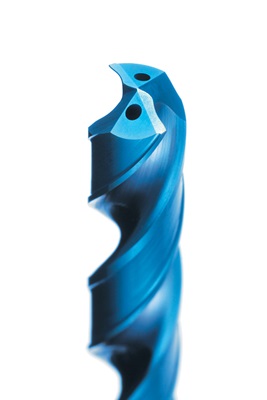
AQUA Drill EX
Oil Hole Deep Drill Series
Source: Nachi America Official Website
(https://www.nachiamerica.com/products/129-aqua-drill-ex-oil-hole-deep-drill-series/
)
In deep hole drilling, this series is capable of one-shot drilling to depths up to 40 times the drill diameter.
This series features spiral flutes along the entire body of the tool and internal coolant supply through oil holes, enhancing cutting performance while improving cooling and chip evacuation. To prevent chip buildup at the bottom of the hole, the drill incorporates deep chip pockets near the cutting edge that temporarily store chips during drilling.
In addition, the use of a multilayer coating technology that withstands temperatures up to 1,100°C ensures stable machining even with heat-retentive, difficult-to-cut materials.
| Lineup | 3D:Ø1.0mm-2.9mm(approx.0.039"-0.114") 5D:Ø1.0mm-2.9mm(approx.0.039"-0.114") 10D:Ø1.0mm-12.0mm(approx.0.039"-0.472") 15D:Ø1.0mm-12.0mm(approx.0.039"-0.472") 20D:Ø1.0mm-10.0mm(approx.0.039"-0.394") 25D:Ø1.0mm-8.0mm(approx.0.039"-0.315") 30D:Ø1.0mm-8.0mm(approx.0.039"-0.315") 40D:Ø1.0mm-7.0mm(approx.0.039"-0.276") パイロットタイプ:Ø1.015mm-12.03mm(approx.0.040"-0.474") |
|---|---|
| Coolant Compatibility | Oilhole |
| Coating Type | "AQUA EX" multilayer nano-coating |
| Manufacturer | Nachi America |
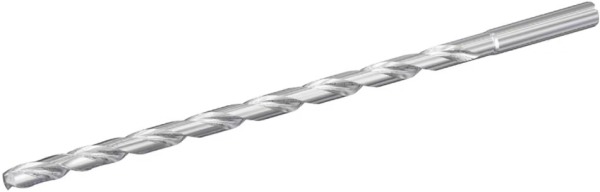
HP Solid-Carbide
Deep Hole Drills
Source:Kennametal Official Website(https://www.kennametal.com/us/en/products/metalworking-tools/holemaking/solid-carbide-drills/hp-solid-carbide-deep-hole-drills.html)
This solid carbide drill is specially designed for high-speed, high-precision deep hole machining on machining centers. It is compatible with a wide range of materials including steel, cast iron, stainless steel, and heat-resistant alloys.
As a common design feature across the series, these drills utilize a high-rigidity solid carbide substrate, which is significantly harder than high-speed steel (HSS), along with multi-step margin lands that serve as guides to support the drill inside the hole. This combination minimizes deflection during machining and enables the creation of high-precision holes that are straight and nearly perfectly round from entry to exit.
| Line | Available in diameters from approximately 2.383 mm to 16 mm (0.0938" to 0.6299"), with drilling depths up to 40×D (40 times the tool diameter). |
|---|---|
| Coolant Compatibility | Compatible with through-coolant systems (equipped with internal coolant supply channels). |
| Coating Type | Single-layer PVD AlTiN coating |
| Manufacturer | Kennametal |
Challenges and Solutions
in Deep Hole Drilling
Tool wear caused by
heat buildup
In deep hole drilling, the tool tip is positioned deep inside the workpiece, making it difficult for external coolant to reach the cutting zone. As a result, cutting heat tends to concentrate on the tool, raising its temperature significantly. When exposed to excessive heat, the hardness of the solid carbide substrate can decrease, accelerating plastic deformation and oxidative wear, which in turn leads to a significant reduction in tool life.
To overcome heat buildup, modern solid carbide drills typically combine two key strategies: heat resistance and heat dissipation.
Specifically, these drills combine heat resistance—by applying high-hardness, heat-resistant coatings such as TiAlN or AlCrN-based layers to protect the tool from high temperatures—with heat dissipation, which involves delivering high-pressure coolant directly to the cutting zone through internal coolant channels to remove and disperse heat.
Maintaining hole straightness is a significant challenge
As tool length increases, fluctuations in cutting resistance and vibration can cause the drill to deflect, reducing the drill’s ability to maintain accurate guidance deep within the hole. Ensuring hole straightness requires reinforcing the drill design itself.
To maintain hole straightness, solid carbide drills address the issue by reinforcing the tool itself.
Specifically, using a high-rigidity solid carbide substrate helps suppress tool deflection. In addition, the use of two or more multi-step margin lands (guide pads) applies pressure against the hole wall to act as a guide, dampening vibrations and helping maintain hole straightness.
In ultra-deep hole drilling, it is common practice to first create a pilot hole using a high-rigidity pilot drill. This helps guide the main drill and prevents the tool tip from deviating during the actual machining process.
Difficult chip evacuation
In materials with high viscosity, such as stainless steel, long continuous chips often form, making chip evacuation particularly difficult. To address this, forced chip evacuation and chip-breaking mechanisms are essential.
Specifically, high-pressure coolant is used to forcibly push chips out while breaking long continuous chips into shorter ones. Chip evacuation is further enhanced by specially engineered flute geometries, optimized for chip pocket volume, and cutting edge designs that minimize cutting resistance.