
Hangzhou GSR-Threads Tools
Index
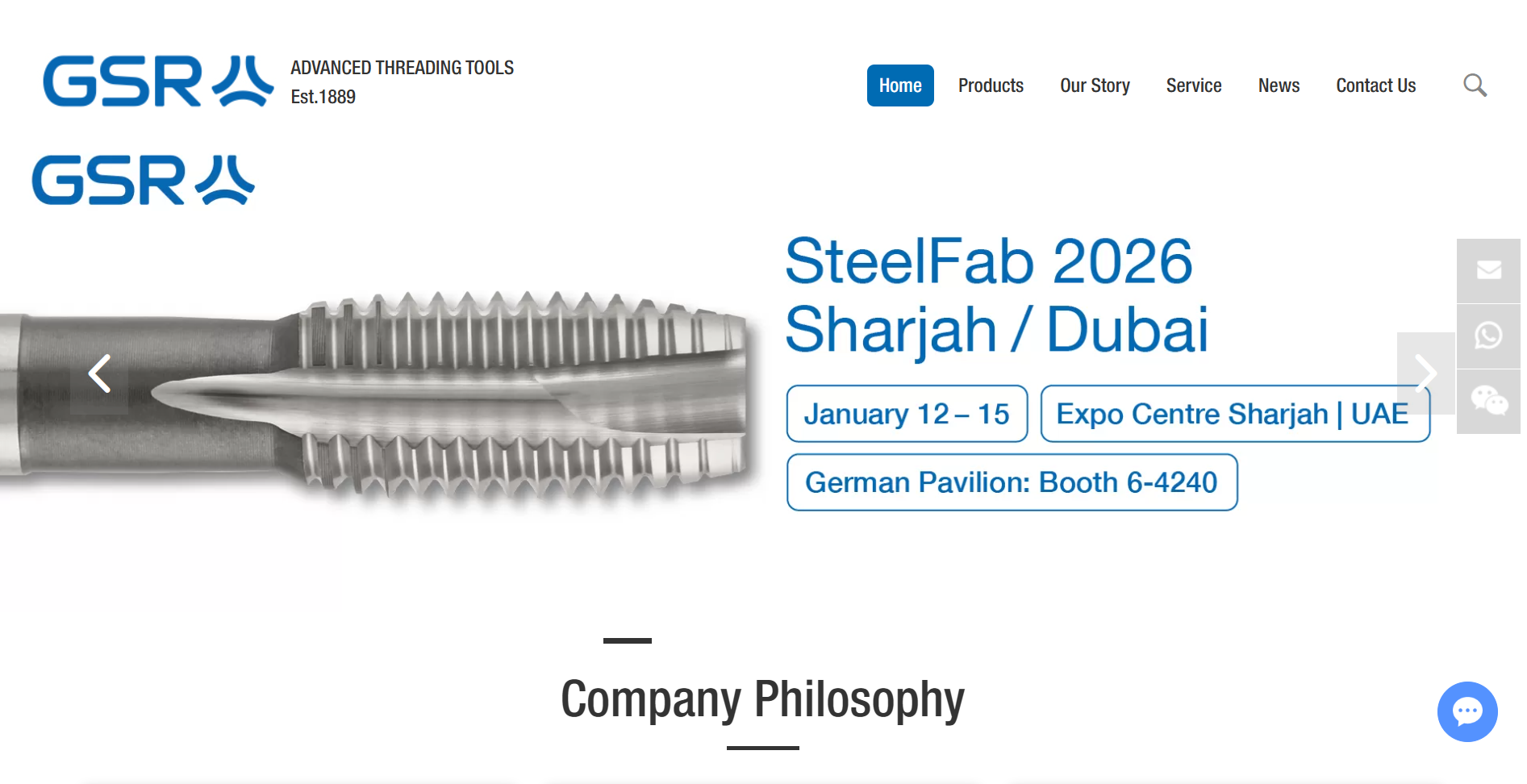
Source: GSR-Threads Official Website
https://www.gsrthreads.com/
https://www.gsrthreads.com/
Hangzhou GSR-Threads Tools
Hangzhou GSR is part of the GSR Group, headquartered in Remscheid, Germany. The Hangzhou facility produces threading and holemaking tools for industrial users who need consistent quality, practical tool options, and cost-effective sourcing.
Overview of GSR-Threads' Carbide Drill Lineup
GSR-Threads offers carbide drill options for applications where standard steel bits may not provide enough hardness, wear resistance, or dimensional stability. Its carbide drill lineup is designed to support accurate drilling, efficient chip evacuation, and reliable performance across a range of machining conditions.
- U-shaped flutes: The flute geometry helps reduce drilling resistance and improve chip evacuation, which can support more stable drilling in deeper holes.
- Surface treatment: Selected bits use surface treatment to help reduce oxidation and rust, supporting longer storage life and more reliable use.
- Multiple shank options: Available designs include cylindrical shanks and 1/4-inch hex shanks, giving users options for bench drills, CNC machines, and hand-held power tools.
Manufacturing Standards and Quality Control
As part of the GSR Group, GSR-Threads benefits from German tooling experience while manufacturing in Hangzhou. The company’s positioning combines practical production efficiency with quality control for buyers looking for repeatable accuracy, stable supply, and competitive sourcing options.
Source: Hangzhou GSR-Threads
https://www.gsrthreads.com/about-us/
https://www.gsrthreads.com/about-us/
Choosing the Right Drill Material: Carbide vs. Cobalt vs. HSS
The right drill material depends on your workpiece material, machine rigidity, production volume, hole tolerance, and budget. Carbide offers excellent hardness, wear resistance, and heat resistance, but it is not always the most practical choice for every shop or drilling setup.
When Carbide Drills Make the Most Sense
Carbide drills are best suited for high-volume production, precision holemaking, and demanding materials such as cast iron, non-ferrous metals, and high-silicon aluminum. Because carbide is extremely hard but relatively brittle, it performs best in rigid setups such as CNC machines or high-quality drill presses.
If the setup has vibration, poor clamping, or chatter, carbide drills are more likely to chip or break. For hand-held drilling, carbide should generally be used only when the bit is specifically designed for that type of application.
HSS, Cobalt, and Carbide: Key Differences
The table below compares the main characteristics of common industrial drill materials and where each one is typically used:
| Feature | High-Speed Steel (HSS) | Cobalt (M35/M42) | Tungsten Carbide |
|---|---|---|---|
| Hardness | Standard | High | Very high |
| Heat Resistance | Low to moderate | Moderate to high | Excellent |
| Brittleness | Low | Moderate | High |
| Best Use Case | General-purpose drilling and mild steel | Stainless steel and alloy steel | Precision drilling, abrasive materials, and mass production |
Cobalt drills are often a practical middle ground between HSS and carbide. They are made from high-speed steel with added cobalt for improved heat resistance, making them useful for tougher materials such as stainless steel and alloy steel where standard HSS may dull quickly.
For shops that do not have the machine rigidity required for carbide, cobalt drills can offer better durability than HSS while reducing the risk of chipping or breakage compared with carbide.
Source: Bosch Professional
https://www.bosch-professional.com/gb/en/knowledge-guide/drill-bits/
https://www.bosch-professional.com/gb/en/knowledge-guide/drill-bits/
Sourcing Reliable Carbide Drills for Industrial Applications
Sourcing carbide drills for industrial use means looking beyond price. Buyers should evaluate each supplier’s product consistency, technical support, carbide grade, coating technology, and drill geometry to ensure the tool matches the application.
Why Brand Comparison Matters for Procurement
For purchasing teams, the key question is not just the upfront tool cost, but the total cost per hole. A higher-quality carbide drill can help extend tool life, improve hole accuracy, reduce scrap, and support more stable production.
Navigating the Global Supplier Landscape
Today’s market includes established European brands, global tooling manufacturers, and cost-efficient Asian suppliers. Comparing options such as GSR-Threads, Bosch, and Seco helps buyers find a supplier that fits their material requirements, production volume, quality standards, and budget.
Source: International Journal of Machine Tools and Manufacture
https://www.sciencedirect.com/journal/international-journal-of-machine-tools-and-manufacture
https://www.sciencedirect.com/journal/international-journal-of-machine-tools-and-manufacture
Summary
Choosing the right carbide drill comes down to matching the tool to your material, machine, and production goals. Carbide drills offer the hardness, wear resistance, and thermal stability needed for demanding industrial applications, but the best option depends on factors such as material hardness, cutting conditions, and required hole quality.
To get the most value from your tooling investment, compare brands by carbide grade, coating technology, flute geometry, and available drill types. The right choice can help improve accuracy, extend tool life, reduce scrap, and support more consistent production.
Compare Top Brands and Suppliers
Review leading carbide drill brands to find a supplier that matches your machining requirements, performance expectations, and supply chain needs.
Company Information
| Address 1 (Germany Headquarters) | GSR Gustav Stursberg GmbH: Schüttendelle 40, 42857 Remscheid, Germany |
|---|---|
| Address 2 (China Manufacturing) | Hangzhou GSR-Threads Tools Co., Ltd.: No. 128, Xianlin Street, Yuhang District, Hangzhou, Zhejiang, China |
| Phone Number | +86-571-88682181 |
| Official Website | https://www.gsrthreads.com/ |